Big 5 Personality Traits With Examples: Five Dimensions in Everyday Life
The big 5 personality traits are openness, conscientiousness, extraversion, agreeableness, and neuroticism, remembered as OCEAN. Their names are easy to memorize; distinguishing them in everyday behavior takes more care. A quiet friend may be considerate, a careful planner may feel anxious, and an outgoing teammate may prefer familiar ideas.
This guide uses a weekend gathering, a team project, and a disagreement to show what each dimension highlights. The examples are hypothetical, not a scoring key. For background focused on emotional reactions, see how neuroticism fits into the Big Five. Here, the goal is to learn which question to ask about a behavior before attaching a personality label.

A Quick Reference for the Five Dimensions
A trait describes a recurring tendency. Higher and lower refer to positions on a dimension, with room between the ends. Every person has a position on all five dimensions.
| Trait | The question it helps you ask | What one observation cannot establish |
|---|---|---|
| Openness | How does someone engage with unfamiliar ideas and experiences? | Whether they are intelligent or enjoy every new activity |
| Conscientiousness | How consistently do they organize and follow through? | Whether one missed deadline reflects their usual pattern |
| Extraversion | How readily do they seek social engagement and express themselves? | Whether a quiet person is unfriendly |
| Agreeableness | How do they approach cooperation and other people's needs? | Whether disagreement means they lack compassion |
| Neuroticism | How readily do they experience worry, irritation, or distress? | Whether one stressful reaction indicates a lasting trait |
These questions help organize observations. They do not convert an isolated action into a trait score or rank someone's worth.
Big 5 Personality Traits With Examples From a Weekend Gathering
Imagine friends organizing a gathering. Everyone faces the same invitations, booking decisions, and uncertain weather. Looking at one shared situation makes the differences between dimensions easier to see.

Openness: Choosing What to Try
Openness concerns curiosity, imagination, and receptiveness to unfamiliar ideas or experiences.
A friend with higher openness might suggest a cooking workshop with an unfamiliar cuisine. Someone with lower openness might prefer the restaurant the group already knows. The useful contrast is their interest in exploration when both options are feasible.
A familiar choice alone says little. Food allergies, cost, or accessibility could decide the venue. Ask whether the person tends to explore unfamiliar possibilities when those constraints are comparable.
Conscientiousness: Making the Plan Happen
Conscientiousness concerns organization, responsibility, and persistence.
A friend with higher conscientiousness might confirm the reservation, check dietary needs, and send the meeting details early. Someone with lower conscientiousness might repeatedly postpone the booking or lose track of what they promised to arrange.
The relevant pattern is follow-through across manageable commitments. One forgotten message during an emergency does not establish low conscientiousness. Nor does having a tidy notebook prove that someone reliably completes tasks.
Extraversion: Joining the Social Activity
Extraversion includes sociability, assertiveness, and energetic engagement.
A more extraverted friend might greet unfamiliar guests and initiate a group game. A less extraverted friend might prefer a small conversation and contribute without taking the spotlight.
Both can enjoy the gathering. Watch how much social participation they usually seek when they have a choice. Being quiet while listening carefully reveals little about how much they care about others.
Agreeableness: Considering Different Preferences
Agreeableness concerns compassion, cooperation, and trust.
When guests want different activities, a friend with higher agreeableness might acknowledge each preference and help find a workable compromise. Someone with lower agreeableness might be less willing to accommodate others or more skeptical of their requests.
Agreeableness does not require accepting every proposal. A considerate friend can say, "That is outside my budget; could we choose something less expensive?" The boundary and the way it is expressed are separate things to notice.
Neuroticism: Experiencing Uncertainty
Neuroticism concerns a tendency toward negative emotions, including worry, irritability, and distress. Emotional stability describes the opposite direction.
If rain threatens the event, a friend with higher neuroticism might keep imagining disappointed guests even after a backup venue is booked. Someone with lower neuroticism might feel less unsettled while checking the forecast and alternatives.
Both can prepare responsibly. The difference here is the emotional response attached to uncertainty. For a fuller explanation of that dimension, see emotional stability through everyday examples.
A Team Project Shows Why the Dimensions Are Different
Now imagine a team preparing a presentation. The deadline stays the same, but the behavior you observe can point toward different questions:
| Project moment | Higher tendency might look like | Lower tendency might look like |
|---|---|---|
| Openness: selecting an approach | Exploring a novel way to explain the topic | Preferring an established presentation format |
| Conscientiousness: completing tasks | Planning milestones and checking commitments | Frequently postponing assigned work |
| Extraversion: discussing progress | Speaking readily and initiating discussion | Preferring written input or a smaller discussion |
| Agreeableness: negotiating workload | Considering teammates' constraints when allocating tasks | Giving less weight to others' needs when allocating tasks |
| Neuroticism: responding to an uncertain outcome | Feeling persistent worry about the presentation | Feeling relatively little distress about the uncertainty |
These are illustrative contrasts, not predictions about performance. A team member can propose something original and miss their deadline. Another can prefer a conventional approach and deliver excellent work.
Also check opportunity: someone may speak often because they are the assigned presenter. Someone may miss a milestone because another team withheld necessary information. The same project outcome can arise through different routes.
In a Disagreement, Separate Participation, Cooperation, and Emotion
Suppose two housemates disagree about overnight guests. One says, "I need us to agree on a limit because I have early shifts."
Speaking up may involve assertiveness, a component of extraversion. Considering the other housemate's needs while explaining the limit concerns agreeableness. Feeling intense worry about the conversation concerns neuroticism. Keeping track of the eventual agreement may involve conscientiousness. Exploring an unfamiliar arrangement may involve openness.
The sentence itself cannot reveal all of those tendencies. You need information about the person's usual approach, their feelings, and the circumstances.
For example, a housemate might calmly state a firm boundary and suggest a compromise. Another might agree immediately while feeling resentful and frightened of conflict. Surface agreement is not enough to infer a complete personality profile. Ask what happened, how the decision was reached, and whether similar patterns recur.
Four Similar Behaviors That Are Easy to Misread
Quietness: Low Extraversion or Something Else?
A person may stay quiet because they prefer less public participation. They may also be tired, unfamiliar with the topic, excluded from the conversation, or still learning the language being used.
Compare situations where they have a comfortable opportunity to contribute. Their preference in those settings is more informative than silence during one difficult meeting. Kindness and helpfulness need separate observations.
Careful Planning: Conscientiousness or Worry?
Two people may check the same reservation. One checks once as part of a reliable routine. Another checks repeatedly because uncertainty feels difficult to tolerate.
Follow-through concerns conscientiousness; the emotional experience around the task may concern neuroticism. Both tendencies can coexist. Checking frequency alone does not identify the reason, and careful planning does not establish how calm someone feels.
Saying No: Lower Agreeableness or a Reasonable Boundary?
Declining a request can reflect time, money, competing responsibilities, or a personal limit. Notice whether the person usually considers others' perspectives, not just whether they agree today.
Someone might refuse an extra shift while helping a colleague find another option. Someone else might accept while treating the colleague dismissively. The answer and the interpersonal approach provide different information.
Choosing Routine: Lower Openness or a Practical Constraint?
A familiar method may be appropriate when errors are costly or experimentation is prohibited. A person can enjoy unusual ideas while following a standard safety procedure.
Look at choices where exploration is possible. Even then, curiosity about art, ideas, and activities need not appear equally strongly. Avoid treating one restaurant preference as a complete measure of openness.
Similar Actions Can Belong to Different Personality Profiles
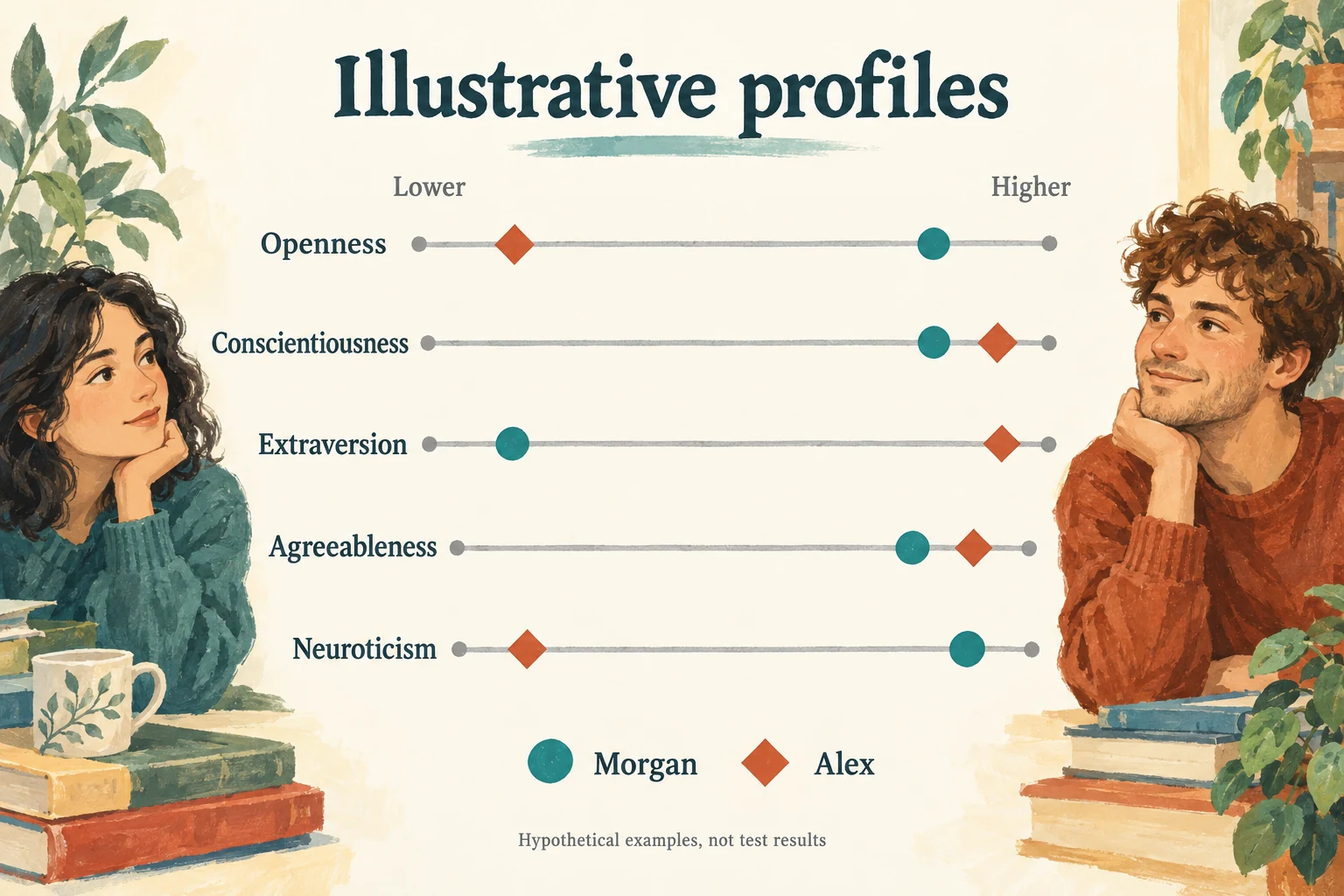
Consider Morgan and Alex, two hypothetical gathering organizers. Both book on time and accommodate their friends' needs. Morgan suggests unfamiliar activities, prefers smaller conversations, and worries about possible problems. Alex favors familiar activities, enjoys leading group discussions, and feels calmer about setbacks.
Their shared behavior does not imply identical profiles. Their differences do not establish which person is more capable. The illustration below represents those imagined tendencies, not measured scores.
Broad dimensions can also contain narrower facets. Soto and John's Big Five Inventory-2 distinguishes sociability, assertiveness, and energy level within extraversion. Someone may enjoy company without wanting to lead every conversation. That extra detail can help explain an apparent mismatch between a broad description and a specific action.
For more on combinations centered on emotional reactions, continue with neuroticism and other Big Five trait combinations.
Practice Distinguishing a Trait From a Situation
To make the big 5 personality traits useful, practice describing evidence before naming a dimension. This is a learning exercise, not a questionnaire.
Start with this observation: "I spoke very little during Tuesday's meeting."
- Identify the relevant question. Was the issue how much public participation you sought? Extraversion may be relevant.
- Write a plausible situational explanation. Perhaps you lacked the briefing document or were interrupted.
- Find a comparison. What happened in another meeting where you knew the topic and had room to speak?
- Use tentative wording. "I often prefer written contributions" describes a pattern more carefully than "I am bad with people."
Try the same process with preparing early, choosing a familiar activity, accommodating a request, or worrying after feedback. For each observation, record a possible dimension and an alternative explanation. If you cannot distinguish them, leave the interpretation open.

If repeated stress reactions are your main interest, a neuroticism self-assessment can support reflection on that dimension. It cannot supply the other four trait scores. Examples and questionnaires should support understanding; persistent distress affecting daily life warrants discussion with a qualified mental health professional.
Frequently Asked Questions
What Are Simple Examples of the Big 5 Personality Traits?
Exploring an unfamiliar idea may illustrate openness; following through on commitments, conscientiousness; initiating a conversation, extraversion; considering another person's needs, agreeableness; and recurring worry under uncertainty, neuroticism. Each example needs context and repetition before it supports a trait interpretation.
Can One Behavior Reflect More Than One Trait?
Yes. Preparing for a gathering may involve organization, concern for guests, and worry about the outcome. Those relate to different dimensions. Ask what the person does, how they approach others, and what they experience emotionally rather than assigning the whole activity to one trait.
Does Being Introverted Mean Being Less Agreeable?
No. Lower extraversion concerns a tendency toward less social engagement or assertiveness. Agreeableness concerns cooperation and consideration. A quiet person can be compassionate and helpful; a talkative person can be considerate or dismissive. Observe those qualities separately.
Does Higher Openness Mean Saying Yes to Every New Experience?
No. Interests, resources, responsibilities, and risks affect choices. Someone can be curious about unfamiliar ideas while declining a particular activity. Look for their broader pattern of engagement when exploration is available, rather than counting every acceptance or refusal.
Can These Examples Tell Me My Big Five Scores?
No. They teach distinctions and suggest questions to explore. Measuring all five dimensions requires a suitable instrument with its own questions and scoring instructions. Do not turn the tables into a checklist or infer someone else's scores from a few remembered interactions.