Neurosis vs Neuroticism Explained for Modern Self-Understanding
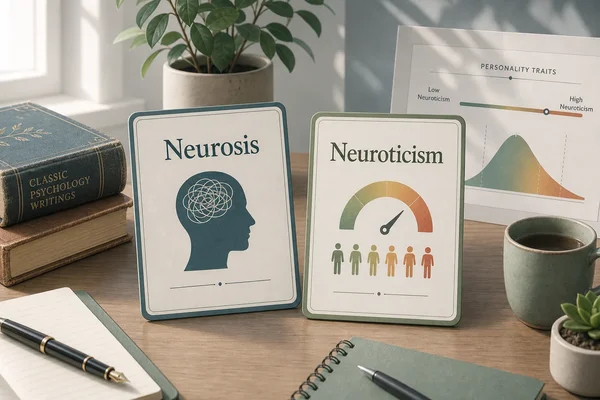
When people search for neurosis vs neuroticism, they are usually trying to separate an old mental health term from a modern personality concept. The short answer is that neurosis is a historical and often vague clinical word, while neuroticism is a Big Five personality trait related to emotional reactivity, worry, and sensitivity to stress. That difference matters because the wrong word can make ordinary self-reflection sound more alarming than it needs to be. If you are exploring your patterns rather than looking for a medical label, a Big Five neuroticism self-check can offer a calmer starting point.
The Quick Difference Between Neurosis and Neuroticism
Neurosis usually refers to a past way of grouping anxiety-related distress, obsessive thoughts, phobias, and emotional conflict. It has been used in psychoanalysis, older psychiatry, and everyday language, but it is not the standard label most clinicians would use today.
Neuroticism is different. It describes a stable personality tendency: how often and how intensely someone experiences negative emotions such as worry, guilt, irritability, self-consciousness, or fear. It appears in the Big Five model along with openness, conscientiousness, extraversion, and agreeableness.
So the practical distinction is simple:
- Neurosis asks, "Is there a distress pattern that may need clinical support?"
- Neuroticism asks, "How emotionally reactive or stress-sensitive is this person's usual personality style?"
This is why two people can have different neuroticism levels without either person having a mental health condition. A trait is a spectrum. A disorder-like problem is about distress, impairment, persistence, and context.
Why Neurosis Is an Older and Less Precise Word
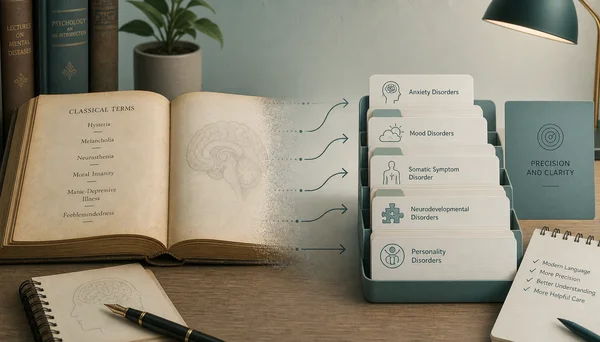
The word neurosis has a long history, which is part of why it causes confusion. At different times, it has described anxiety, phobias, obsessive patterns, bodily symptoms without an obvious physical explanation, and emotional conflict. In some older writing, the plural form "neuroses" described several categories rather than one specific condition.
Modern mental health language tends to avoid that broad umbrella because it can hide important differences. A person with panic attacks, a person with obsessive-compulsive symptoms, and a person with trauma-related distress may all have intense anxiety, but they may need different forms of assessment and support. Calling all of that "neurosis" can make the picture less clear.
That does not mean the word is useless in every setting. You may still see it in older books, psychoanalytic discussions, and articles explaining the history of mental health classification. But when someone asks, "Is neurosis a mental illness?" the safest modern answer is: not as one single current diagnosis. It is better understood as an older umbrella term that has largely been replaced by more specific language.
Neuroticism as a Big Five Personality Trait
Neuroticism belongs to personality psychology, not to a disease category. It describes a tendency to respond to stress, uncertainty, criticism, conflict, or possible loss with stronger negative emotion. Someone higher in neuroticism may replay conversations, notice threats quickly, feel guilty after small mistakes, or become unsettled by changes that another person handles easily.
Lower neuroticism is often described as higher emotional stability. A person lower on this trait may still feel stress, sadness, anger, or fear, but those states may pass more easily or feel less consuming. Neither end of the spectrum is a moral ranking. Higher sensitivity can bring challenges, yet it can also come with carefulness, empathy, and early awareness that something needs attention.
This is where an educational tool can be useful. An educational neuroticism test should be treated as a mirror for patterns, not as a medical conclusion. It can help you notice whether your stress responses are occasional, situational, or part of a broader personality style worth understanding.
Neurosis vs Neuroticism Side by Side
| Question | Neurosis | Neuroticism |
|---|---|---|
| Main meaning | Older term for distress patterns often linked with anxiety or emotional conflict | Big Five trait involving emotional reactivity and stress sensitivity |
| Current status | Historical, vague, and not usually used as one modern clinical label | Widely used in personality research and self-assessment |
| Scope | Often points to symptoms or impairment | Points to a personality dimension on a spectrum |
| Everyday example | "My worry and compulsive checking are disrupting my life" | "I tend to worry, react strongly, and need time to calm down" |
| Best next question | Is this causing ongoing distress or interfering with life? | What patterns show up in stress, relationships, and decisions? |
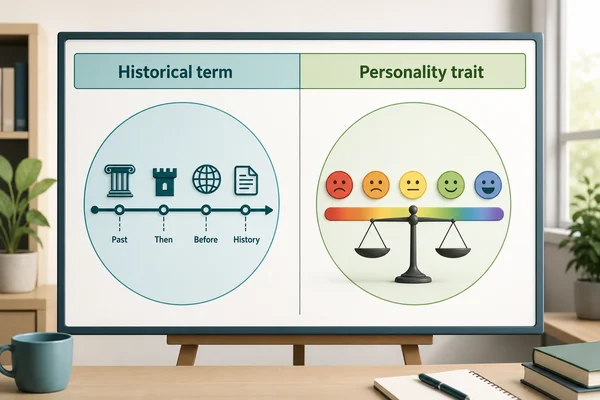
The table shows why the terms should not be swapped casually. "Neurotic" is sometimes used as an insult, but that use is imprecise and often unfair. A person can be high in neuroticism and still function well. A person can also have serious distress even if they do not think of themselves as "neurotic."
The line to watch is not the label. It is the impact. If worry, avoidance, intrusive thoughts, panic-like sensations, sleep disruption, or relationship strain are persistent and difficult to manage, the concern is no longer just word choice. It may be time to talk with a qualified professional.
Neurosis vs Anxiety, Psychosis, and Hysteria
Searches around this topic often include neurosis vs anxiety, neurosis vs psychosis, and neurosis vs hysteria. These comparisons are useful because they show how older terms map imperfectly onto modern language.
Neurosis vs anxiety
Anxiety is a normal human response to uncertainty, pressure, or future threat. Anxiety disorders involve worry or fear that is persistent, difficult to control, and disruptive to daily life. Neurosis was once used broadly for anxiety-related problems, but modern language is usually more specific: generalized anxiety disorder, panic disorder, phobia-related disorders, obsessive-compulsive disorder, trauma-related conditions, or other categories depending on the presentation.
For everyday self-understanding, it is clearer to describe the actual pattern: "I avoid social events," "I cannot stop checking," "I feel physical tension before ordinary tasks," or "I worry for hours after feedback." Specific descriptions help more than the single word neurosis.
Neurosis vs psychosis
Psychosis is a very different concept. It involves some loss of contact with reality, such as hallucinations, delusions, severely disorganized thinking, or major difficulty recognizing what is real. Neurosis, in its classic use, generally referred to distress without that kind of reality break.
This distinction matters because psychosis-like experiences deserve prompt professional attention. They are not personality quirks, and they should not be handled as a simple self-improvement issue.
Neurosis vs hysteria
Hysteria is another older term that modern mental health writing usually avoids. Historically, it was applied to a wide range of emotional and physical symptoms, often in ways that were stigmatizing and imprecise. Today, clinicians use more specific categories when symptoms affect the body, mood, memory, anxiety, or behavior.
If someone uses hysteria in casual speech, it is worth slowing down and asking what they actually mean. Do they mean panic, intense emotion, physical symptoms under stress, dissociation, or something else? More precise language is kinder and more useful.
When Neurotic Patterns Deserve Extra Support
Neuroticism itself is not a problem that must be "fixed." It becomes important to seek extra support when emotional reactivity begins to shrink a person's life. A few signs deserve attention:
- worry or fear feels hard to control for weeks or months;
- avoidance keeps you from work, school, relationships, health care, or basic tasks;
- physical symptoms such as racing heart, stomach upset, trembling, or muscle tension are frequent and distressing;
- reassurance helps only briefly before the worry returns;
- intrusive thoughts or checking rituals consume significant time;
- sleep, appetite, concentration, or daily functioning changes noticeably.
These signs do not prove a specific condition. They simply suggest that self-reflection may not be enough by itself. A primary care clinician or licensed mental health professional can help sort out physical, emotional, and situational factors.
How to Use the Distinction for Self-Reflection
The most practical use of the neurosis vs neuroticism distinction is not to label yourself. It is to choose the right next question. Instead of asking, "Am I neurotic?" try asking, "What exactly happens when I feel threatened, criticized, uncertain, or overwhelmed?"
Use this simple reflection sequence:
- Name the trigger. Was it conflict, uncertainty, rejection, responsibility, health worry, or loss of control?
- Name the reaction. Did you ruminate, seek reassurance, avoid, over-prepare, snap, freeze, or feel physical tension?
- Rate the impact. Did the reaction pass, or did it disrupt your day, relationships, sleep, or decisions?
- Look for patterns. Is this tied to one stressful season, or does it appear across many areas of life?
- Choose one small adjustment. Try a pause before reassurance-seeking, a written worry window, a grounding exercise, or a conversation with a trusted person.
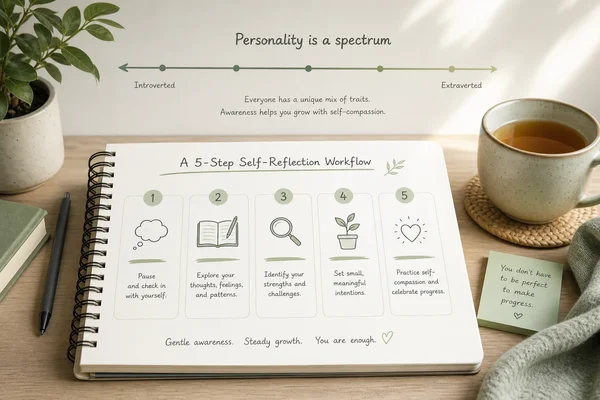
This kind of tracking turns vague labels into workable information. If you want a structured way to notice your emotional-stability patterns, an online personality self-reflection tool can support that process without turning the result into a verdict.
A Modern Way to Think About Neuroticism Without Labeling Yourself
A helpful modern frame is this: neurosis belongs mostly to the history of how distress was described, while neuroticism belongs to the ongoing study of personality differences. The first word can be useful when reading older material. The second word is more useful when reflecting on your ordinary emotional style.
High neuroticism does not mean you are broken. It may mean your mind notices possible problems quickly, reacts strongly to uncertainty, and needs intentional recovery time after stress. That information can guide better habits: clearer boundaries, more realistic self-talk, steadier sleep, less compulsive reassurance, and earlier support when distress grows.
For NeuroticismTest.com, the healthiest use of this topic is self-awareness. Explore your patterns gently, compare them with your lived experience, and remember that a calm self-reflection tool is only one piece of the picture. If symptoms feel intense, persistent, confusing, or unsafe, professional care is the more appropriate next step.
FAQ
Why is neurosis no longer used?
Neurosis is no longer widely used because it is too broad and vague for most modern clinical communication. Older uses covered anxiety, phobias, obsessive patterns, emotional conflict, and physical symptoms under stress. Today, professionals usually prefer more specific terms that describe the actual pattern and support needs.
Are neurosis and neurotic the same thing?
No. Neurosis usually points to an older idea of anxiety-related distress or emotional conflict. Neurotic is an adjective that people use in several ways, sometimes casually and sometimes unfairly. Neuroticism is the more precise personality term, meaning a tendency toward stronger negative emotion and stress sensitivity.
What are the three types of neurosis?
Different older sources used different groupings, so there is no single official three-type list today. Common historical examples included anxious neurosis, depressive neurosis, and obsessive-compulsive neurosis. Modern language usually replaces those broad labels with more specific condition names and clinical descriptions.
What is neuroticism called now?
Neuroticism is still commonly called neuroticism in the Big Five personality model. It is also sometimes described as low emotional stability, negative emotionality, or emotional reactivity. These phrases all point to a spectrum, not a medical label.
Is neurosis a mental illness?
In modern usage, neurosis is not usually treated as one current mental illness category. It is an older umbrella term. If a person has anxiety, compulsive patterns, panic symptoms, trauma reactions, or mood symptoms that interfere with life, the better step is to describe those experiences specifically and seek appropriate support.
What is the plural of neurosis?
The traditional plural is neuroses. You may see it in older psychology books or articles about the history of mental health terminology. In everyday modern writing, it is often clearer to avoid the plural and name the specific pattern being discussed.
Can neurosis have physical symptoms?
Older uses of neurosis often included physical symptoms connected with distress, such as tension, trembling, sweating, stomach upset, sleep problems, or a racing heart. Physical symptoms can also come from many medical causes, so recurring or concerning body symptoms should be discussed with a health professional.