Anxiety Anger Guilt and Sadness Are Referred to as What?
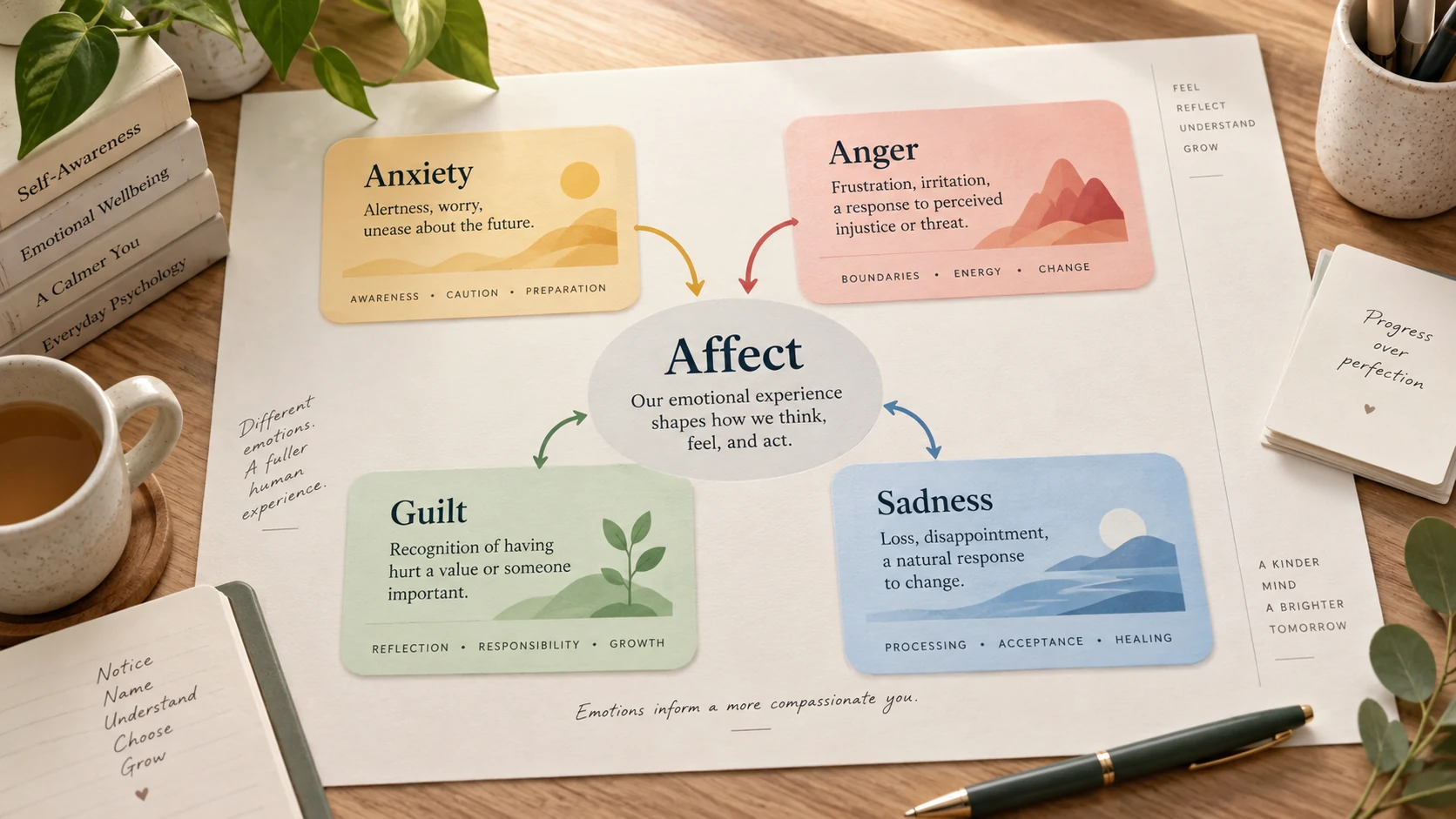
Anxiety, anger, guilt, and sadness are referred to as affect in broad psychology language. More specifically, because they feel unpleasant or distressing, they are often discussed as negative affect, negative emotions, or aversive emotional states. That answer matters because a search like "anxiety anger guilt and sadness are referred to as" is usually looking for a category, not a clinical label. These feelings can be intense, but they are also normal parts of human emotional life. If you are exploring why you react strongly to stress, a gentle emotional stability self-reflection tool can help you notice patterns without turning a feeling into a judgment about who you are.
The Short Answer: They Are Forms of Affect
In psychology, affect is the umbrella term for felt emotional experience. It can include emotions, moods, and broader feeling states. Under that umbrella, anxiety, anger, guilt, and sadness usually fall on the unpleasant side of the emotional spectrum, so "negative affect" is the more precise phrase when the question is asking about their shared tone.
The word "negative" does not mean bad, wrong, or useless. It means the feeling has an unpleasant valence. Anger may signal that a boundary feels crossed. Anxiety may signal anticipated threat or uncertainty. Guilt may signal concern about responsibility or repair. Sadness may signal loss, disappointment, or a need for comfort. Each one can become difficult when it is intense, persistent, or hard to regulate, but the basic category is still affect.
This is also why the related keyword "anxiety anger guilt and sadness are referred to as affect" is the cleanest answer. If the prompt appears in a quiz, "affect" may be the expected broad answer, while "negative affect" may be the better explanatory answer.
Affect, Emotion, and Mood Are Not Exactly the Same
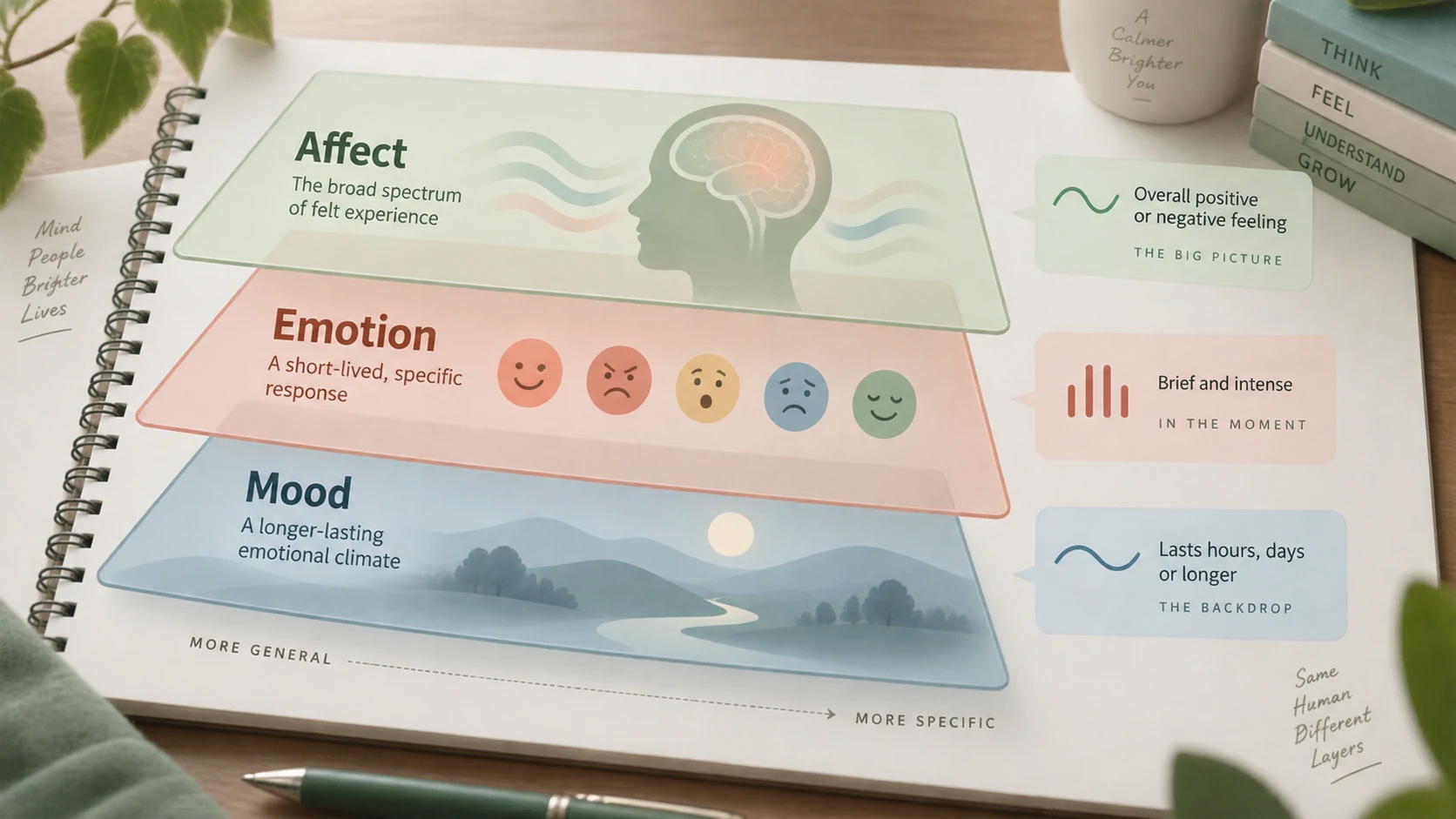
Everyday language often uses feeling, emotion, mood, and affect as if they mean the same thing. Psychology separates them because each word points to a different level of experience.
Affect is the broad category
Affect is the widest term. It describes the subjective experience of feeling, from pleasant to unpleasant and from mild to intense. Positive affect includes states such as joy, interest, enthusiasm, or calm engagement. Negative affect includes states such as fear, nervousness, anger, guilt, shame, sadness, and distress.
That broadness is useful because it lets researchers and educators talk about emotional tone without pretending every moment fits one simple label. A person may feel tense, disappointed, and guilty at the same time. Affect gives language for the overall emotional field.
Emotion is usually more specific
An emotion is often a more specific response to something that matters to you. Anger may arise after an insult. Sadness may follow a loss. Anxiety may build around a future threat. Guilt may follow the belief that you violated a value or harmed someone.
Emotions usually include body signals, thoughts, action urges, facial expressions, and behavior patterns. That is why anxiety can come with muscle tension or a racing heart, and anger can come with a strong urge to confront, correct, or protect.
Mood tends to last longer
A mood is often less tied to one obvious trigger and may last longer. You might have an anxious mood, an irritable mood, or a low mood without being able to name one single event that caused it. Mood is still affective, but it is more like the emotional weather than a single emotional spark.
Why Anxiety, Anger, Guilt, and Sadness Often Travel Together
These emotions can feel separate on paper and tangled in real life. Anxiety can make the body feel braced for threat. If that threat feels unfair, embarrassing, or impossible to control, anger may appear quickly. Guilt can follow anger if you regret what you said, or it may appear before anger if you feel responsible for keeping everyone comfortable. Sadness can sit underneath both, especially when the situation involves rejection, disappointment, or loss.
This overlap does not mean the feelings are the same. It means affective states influence one another. A person who is anxious before a difficult conversation may become irritable because their nervous system is already on alert. Someone who feels guilty for having needs may become sad because they keep suppressing those needs. A person who feels socially anxious may also feel anger afterward, especially if they replay the interaction and judge themselves harshly.
A practical way to separate the tangle is to ask four plain questions:
- What am I afraid might happen?
- What feels unfair, blocked, or crossed?
- What do I think I did wrong or failed to do?
- What loss, disappointment, or unmet need is present?
Those questions are not a replacement for support when emotions feel overwhelming. They are simply a way to translate a cloud of negative affect into clearer emotional information.
Core, Self-Conscious, and Inhibitory Emotion Labels
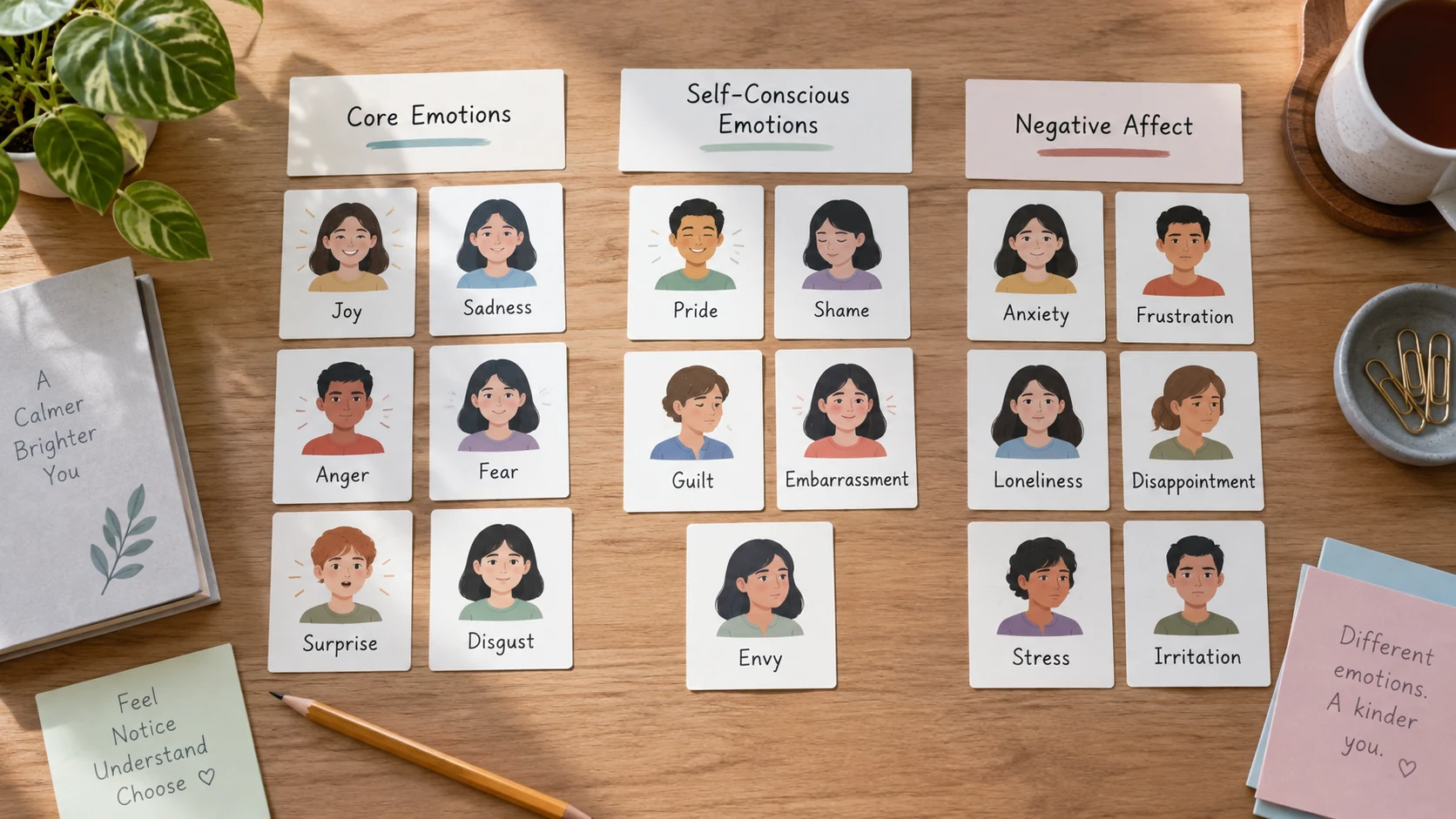
Another reason this keyword is confusing is that different models sort emotions in different ways. Some basic emotion theories emphasize a small set of core emotions, often including anger, fear, sadness, disgust, enjoyment, surprise, and sometimes contempt. Other educational models use a different list. For example, some emotion-focused frameworks treat sadness, anger, fear, joy, excitement, and disgust as core emotions, while anxiety, guilt, and shame may be described as emotions that inhibit or cover more direct core emotions.
Guilt also belongs to a group often called self-conscious emotions. These emotions depend on self-evaluation and social meaning. You usually need some sense of "I did something," "I should have done something," or "others may judge me" for guilt to appear. That makes guilt different from simple fear or sadness, even though it can overlap with both.
So, what is a mix of anger and sadness called? There is no single universal term. People may call it hurt, grief, resentment, bitterness, disappointment, or heartbreak, depending on the situation. The useful question is less "What is the perfect label?" and more "What is each part trying to tell me?"
This is where an educational neuroticism test can fit naturally. Neuroticism is not the same thing as anxiety, anger, guilt, or sadness. It is a Big Five personality trait related to how often and how strongly a person tends to experience emotional reactivity, stress sensitivity, and negative affect.
How Negative Affect Connects With Neuroticism
Neuroticism is one of the Big Five personality traits. In everyday terms, it describes a tendency toward emotional sensitivity, worry, rumination, stress reactivity, and vulnerability to unpleasant emotions. Someone higher in neuroticism may notice threat quickly, feel criticism deeply, or take longer to return to baseline after stress. Someone lower in neuroticism may still feel anxiety, anger, guilt, and sadness, but those states may arise less often or pass more easily.
This connection is why affect language is helpful for self-understanding. Instead of saying "I am an angry person" or "I am too anxious," you can say, "I am noticing a pattern of negative affect under stress." That wording creates space. It points to a pattern that can be observed, reflected on, and managed.
Biology, learning history, current stress, sleep, relationships, culture, and coping habits can all influence affect. Personality traits can shape the starting point, but they do not erase choice or growth. Emotional stability is not about never feeling negative affect. It is about recognizing feelings sooner, responding with more flexibility, and knowing when to seek extra support.
A Gentle Way to Use This Answer for Self-Reflection
The phrase "anxiety anger guilt and sadness are referred to as" has a simple answer: affect, and more specifically negative affect. The more useful next step is to notice how those states show up in your own life. Do they appear mostly under time pressure? After conflict? When you feel judged? When you are tired? When you are trying to meet impossible standards?
Try tracking three details for a week: the situation, the strongest feeling, and the action urge. You might notice that anxiety leads to over-preparing, anger leads to withdrawing, guilt leads to over-apologizing, or sadness leads to seeking quiet. None of these patterns make you broken. They are clues about how your mind and body try to protect you.
If you want a structured starting point, you can review a self-reflection tool for emotional patterns and use the result as a conversation with yourself, not as a clinical conclusion. If your emotions feel unmanageable, interfere with daily functioning, or include thoughts of harming yourself or someone else, it is wise to contact a qualified mental health professional or local emergency support.
FAQ
Are anxiety, anger, guilt, and sadness called affect?
Yes. In broad psychology language, they are forms of affect because affect refers to felt emotional experience. Since these feelings are usually unpleasant, they are also commonly discussed as negative affect or negative emotional states.
Is negative affect the same as neuroticism?
No. Negative affect is a type of emotional experience. Neuroticism is a personality trait linked with a greater tendency to experience negative affect, especially under stress. The two are related, but they are not identical.
Can anxiety cause anger outbursts?
Anxiety can contribute to anger outbursts for some people because a threatened, tense, or overstimulated nervous system may react defensively. The anger is often easier to see from the outside, while the anxiety underneath may be less obvious.
What are the 7 core emotions?
There is no single list accepted by every model. A common educational list includes anger, fear, sadness, disgust, enjoyment or joy, surprise, and contempt. Other frameworks use six or more emotions, so it is best to treat any list as a model rather than a final map of human feeling.
What is a mix of anger and sadness called?
It depends on the situation. People may describe the mix as hurt, grief, resentment, bitterness, disappointment, or heartbreak. Naming both parts can be more accurate than forcing one label.
What is the relationship between anger and social anxiety?
Social anxiety can involve fear of judgment, rejection, embarrassment, or making mistakes. Anger may appear when a person feels exposed, misunderstood, ashamed, or frustrated with themselves after a social event. That does not mean anger and social anxiety are the same thing; it means they can interact.
Are these emotions always unhealthy?
No. Anxiety, anger, guilt, and sadness can all carry useful information. They become more concerning when they are very intense, long-lasting, hard to regulate, or disruptive to daily life. In those cases, extra support can help.